
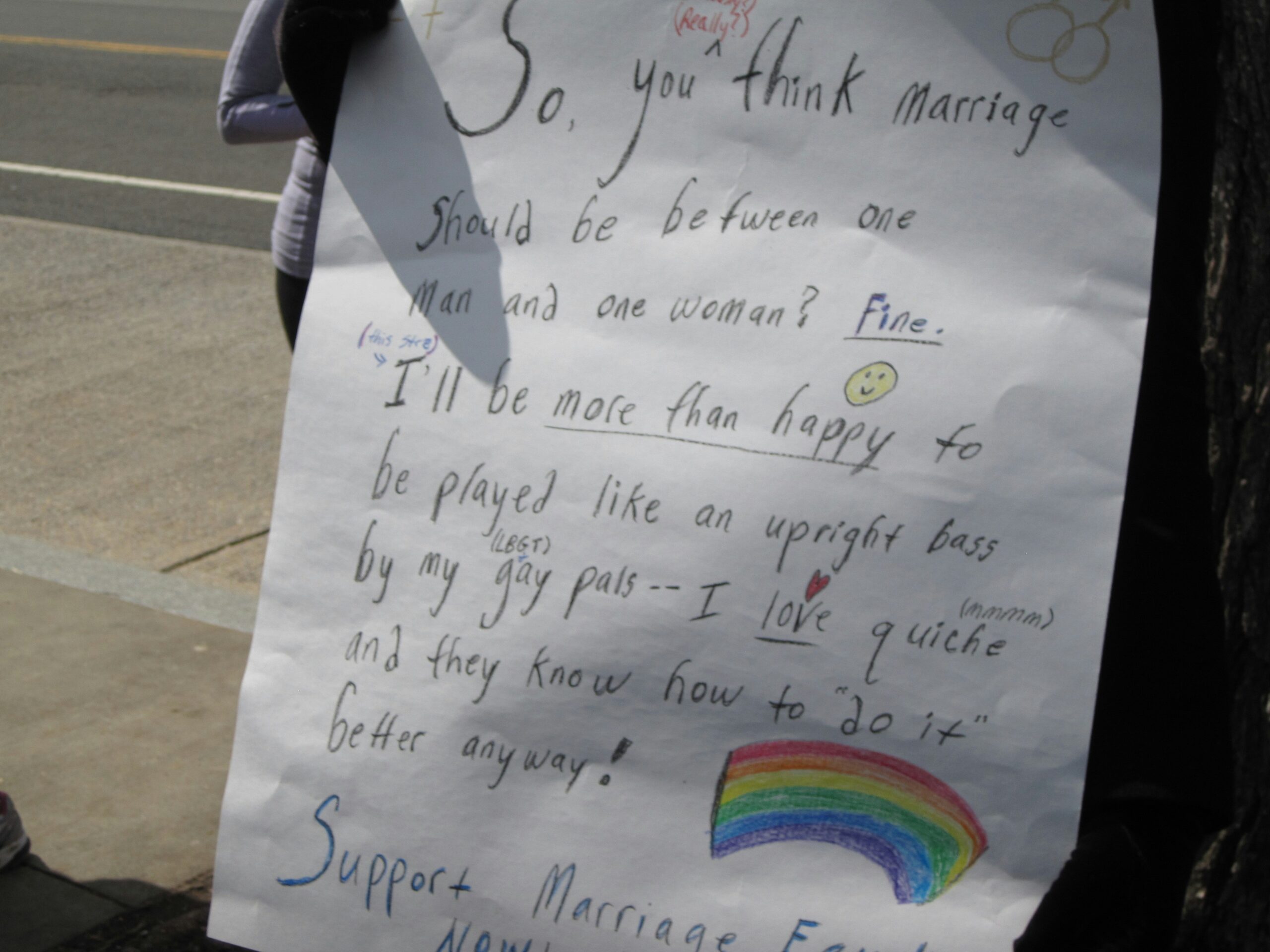
It’s already been over 10 years since same sex marriage was deemed legal on a federal level in the United States. While this decade-long stretch has instilled a sense of relief and joy in the LGBTQIA2s+ community, it’s far from being a happily ever after to the whole story.
Its status as federally protected is not set in stone and can be overturned at any time. Many groups have still been fighting against marriage equality this whole time, and just as ruthlessly and aggressively as ever. It is important to recognize these groups’ consistent efforts, as well as those who are fighting just as hard to stop them.
How same-sex marriage was legalized in the U.S.
The legality of same-sex marriage, even if desired for a long time, only started materializing around the mid-nineties. People had formed many civil unions that helped establish some recognition of same-sex marriage at the state level. However, it was seen as separate but equal to heterosexual marriage, thus denying it the rights that also came with heterosexual marriage.
From the mid-nineties to the mid-two-thousands, marriage equality had several roadblocks put in its way. Things like the Defense of Marriage Act and President Bush’s public denunciation of same-sex marriage only made the concept more difficult to bring to fruition. Massachusetts, being the first state to legalize marriage equality, was a great boost in morale. Unfortunately, it was a gleaming beacon in the middle of an otherwise dark decade.
It wasn’t until the late 2000s, and the historic presidential support given by Barack Obama, that marriage equality began to gain traction. He declared the Defense of Marriage Act unconstitutional and heavily requested that the Supreme Court stop trying to save it. This had a large domino effect, eventually leading to the legal case Obergefell v. Hodges in 2015. The Supreme Court found that any state’s attempt to restrict or ban same-sex marriage, or failure to recognize a legally performed same sex marriage in another state, was a violation of the 14th Amendment. When President Obama heard of the verdict in the case, he described it as “A victory for America”.
Nationwide organizations want a nationwide ban on same-sex marriage
While the securing of marriage equality’s legal status is great, it’s in no way permanent or set in stone. Many people in groups came together to change laws to make it a reality. However, just as many groups and people are coming together to attempt to change the laws back.
One of the most recent, yet by far the largest, of these groups is known as Greater Than. In reality, this one group is a giant coalition of 47 other smaller groups, all with the same anti-marriage equality agenda. They all consist of a right-leaning and conservative political core. Some of the leading organizations are the American Family Association, Family Research Council, Chuck Colson Center for Christian Worldview, and many similar organizations. Individually, they’ve all gone after marriage equality and similar LGBTQIA2s+ interests in the past. While their individual efforts have been a series of headaches at best, their combined efforts have the potential to be a lot more dangerous and, unfortunately, effective.
Many of these groups tend to have a religious focus. Many religious groups are no strangers to anti-LGBTQIA2s+ viewpoints and movements. The Southern Baptist Convention, for example, has overturning Obergefell v. Hodges set as one of its primary objectives. Like many similar religious organizations, they claim same sex marriage as blasphemous, no matter what the law says. They have also fought tooth and nail against legislative attacks on their “conversion” centers, claiming they have a right to “heal” those within. Unfortunately, it’s very unlikely that they will stop their efforts anytime soon, so it’s best to be ever vigilant of them.
State decided same-sex marriage rights: a sneaky workaround
Aside from an outright ban, groups targeting marriage equality can go for a more deceptive tactic. They argue that same-sex marriage shouldn’t be something decided at a federal level. Instead, they offer to let each state individually decide whether or not same-sex marriage is legal. These groups attempt to pass off the idea as a more reasonable compromise. In reality, this only leaves the fate of same sex marriage vulnerable in any state. It also turns this right into a geographically dependent one. LGBTQIA2s+ people in unsupportive states would either need to move to another state or marry in secret. Both of these options leave LGBTQIA2s+ individuals unfairly burdened.
Organizations and representatives have also attempted less direct tactics to undermine the federal protection of marriage equality. Texas, Tennessee, Missouri, and a few other states have tried to introduce a separate class of marriage that is exclusively defined as between one man and one woman. Assumingly, this would leave other types of marriages to be seen as “illegitimate” in the eyes of the state. However, this tactic would only work if federal law did not generally preempt state law. Any introduction of a secondary, protective distinction for heterosexual marriage would violate marriage equality’s federal protection. Equality can’t exist in a system that has multiple, differently treated classifications.
Why the recent flare-ups in anti-same-sex marriage support?
One of the largest overarching reasons for the current rise in anti-same-sex marriage attacks comes from the Supreme Court’s recent increase in overturning settled laws. With Dobbs v. Jackson overturning Roe v. Wade, leading to abortion no longer being a federal right, Republican and conservative Law groups now feel a renewed sense of confidence and motivation in their efforts.
Another important reason for this sudden bump in anti-marriage equality efforts is the ever-intensifying political polarization within the country. General support for marriage equality has dropped by 6% in four years. Support among republicans has dropped bya jaw dropping 18% within that same time frame.
What, and who, is keeping same-sex marriage safe?
Despite the opposition, protecting same sex marriage is not a hopeless cause. A large squadron of groups and organizations is defending same-sex marriage from this formidable legion. Their methods and tactics range from directly confrontational to more passive and sympathy-based. This diverse approach creates opportunities for both pushing back against oppressive forces and getting more people to see the importance of protection and even potentially join in the efforts.
Legal protection
Legal firms and organizations, such as Lambda Legal, have had decades of experience dealing with the efforts of anti-LGBTQIA2s+ organizations. Alongside direct challenges to Obergefell v. Hodges, Lambda Legal puts tremendous effort and time into preventing the opposition from attempting to circumvent the federal law via loopholes. They dismantle any erroneous arguments attempting to use the First Amendment asa as a protective measure for anti-marriage equality laws and procedures.
Other organizations, like the Human Rights Campaign, target state bills specifically. In 2023, they had an incredible 85% success rate in defeating anti-LGBTQIA2s+ bills. They also use connections in Congress and the scientific community to present data and legislative analysis, which helps sway the opinions and decisions made by lawmakers and Congress.
Awareness campaigning
Some may write this strategy off as “preaching to the choir”. Conservatives and Republicans have a reputation for being set in their ways, so wouldn’t the only people willing to listen be those who are predisposed to be supportive of the issue? However, this mindset ignores the invaluable middle ground: the undecided and misinformed. Freedom To Marry, a political campaign responsible for Obergefell v. Hodges, made this discovery at a crucial point in its journey.
They found a significant percentage of Americans who were under the impression that LGBTQIA2s+ Individuals only wanted same sex marriage purely for the benefits and protective rights entailed. That’s when Freedom To Marry realized how detrimental only focusing on one aspect of a cause can be. While these rights and benefits are, of course, highly important to the cause, neglecting to emphasize the emotional and romantic stakes involved gave an inaccurately clinical impression. From this, they put more focus on portraying this aspect of the issue. This resulted in a more sympathetic response from this undecided and misinformed percentage.
While many would assume that religious organizations are exclusively on the opposition’s side, the Interfaith Alliance is a fascinating exception. Interfaith Alliance often points out the hypocritical nature of anti-marriage practices. Breaking up same-sex families only ends up hurting the children involved. This fact discredits how much these organizations go on about how “unsafe” children of same-sex families are. Bans on marriage equality are a direct violation of religious freedom and true democracy. The love that same-sex couples have for each other and their families could never possibly be illegitimate or incorrect. No matter how hard conservative Christian groups try to portray the opposite, the truth can’t be changed.
Personal testimonials of same-sex families
Many same-sex couples have given testimonials on their experiences with marriage. They provide great insight into the issue on a personal level. Where statistics offer a great logistical argument, these shared experiences and difficulties offer a great sympathetic angle to the situation. They impart a sense of hurt and betrayal that these couples felt from their local communities and government. This is especially prevalent in the case of people like Representative Allison Dahle.
Deb Butler’s story describes how her once disdained attitude towards marriage as an institution turned to a deep appreciation once the concept they come a reality for her and her partner. It delves into the unfortunate coping mechanism that some people in marginalized groups utilize when denied a right or benefit. They write off the denied right as “unimportant” or “archaic”. It’s a tragic mindset that often leads to a sense of hopelessness. This inaction creates difficulty for those fighting for that denied right.
More resources for same-sex marriage support
GLAAD’s website is a treasure trove of resources and information on this topic and LGBTQIA2s+ issues in general. They host multiple great opportunities to join the cause yourself, via direct involvement or monetarily.
American Civil Liberties Union, Lambda Legal, and the National LGBTQ+ Bar Association are great for those wanting more legal information. They also provide excellent legal services for LGBTQIA2s+ individuals who require legal representation.
Protecting same-sex marriage is just as important a battle as it was to become a federally protected right. Time isn’t enough to make these hostile and dedicated opposition groups go away. To ensure that the battle fought at Obergefell v. Hodges wasn’t pointless, we need to be ever vigilant in protecting same-sex marriage, and the real lives of the people it affects.
Check Out:
Why ‘Heated Rivalry’ is the Show We Need in 2026
Uncertain Futures: The LGBTQIA+ Community’s Continuous Battle for Equal Rights









Be First to Comment