
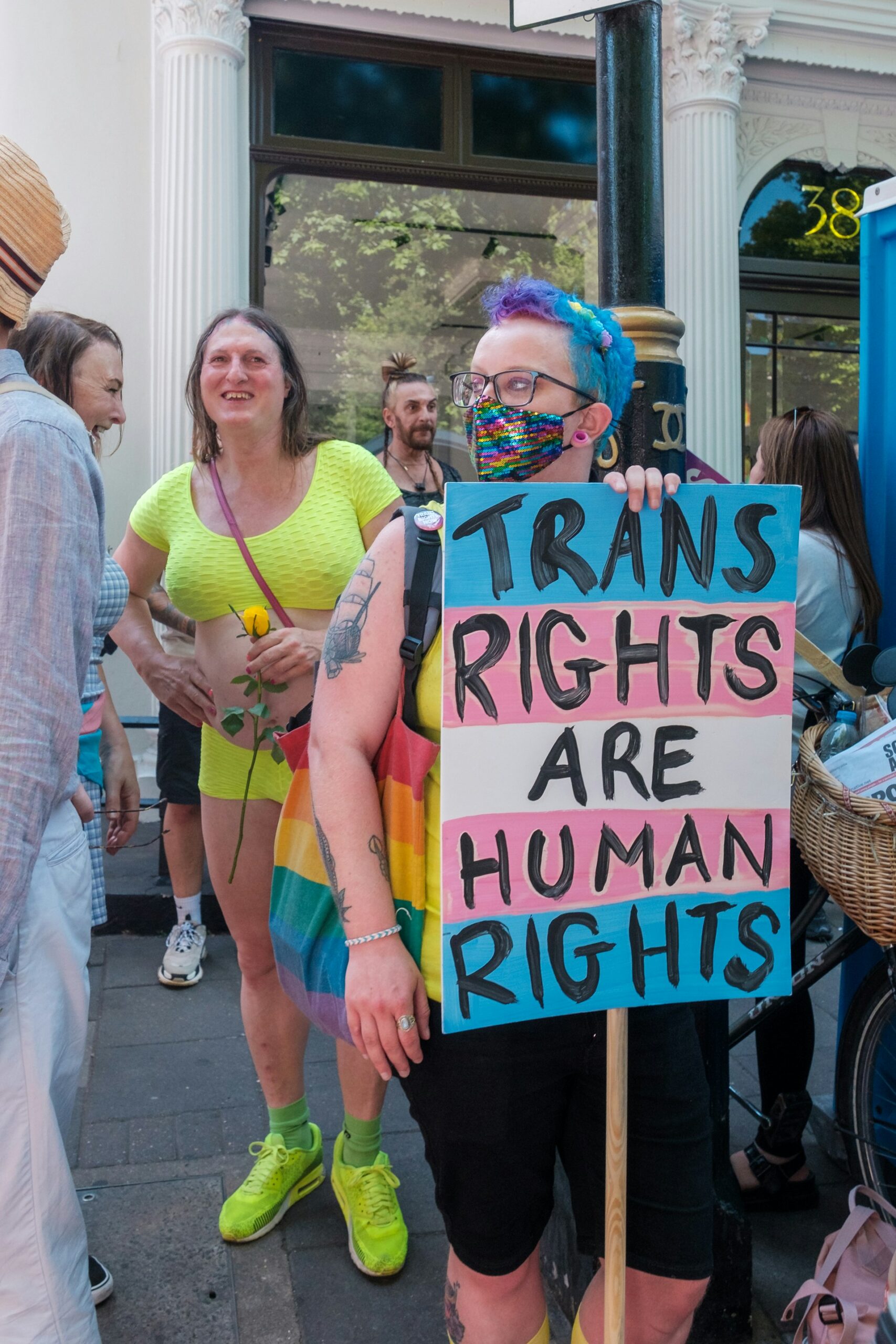
Many of the attacks that trans women face often follow the same old arguments. Most of them boil down to a cult-like adherence to strictly binary concepts of both gender and sex. These binaries, however, are not as ancient or sacred as oppressors believe. These “traditional” values are no more traditional than the non-binary viewpoints they hope to quash. In the same spirit, the unchangeable attitude towards gender roles is ironic. This is especially true given the concept’s lack of consistency between differing cultures in its early years. With this lack of real foundation, how much power does society’s insistence on binary gender have against those truly fighting it?
Trans targets
One of the more direct forms of oppression for trans women is physical. A staggering 40%-50% of trans women have experienced physical violence. An even more harrowing 50%-60% of them have experienced sexual violence. The fact that roughly half of all trans women experiencing physical and/or sexual violence paints a grim picture. The absence of media coverage of such stories suggests an unfortunate trend. It creates the impression of indifference among those who have the authority to make a change.
When looking into the intersectional cases of sexual violence, some eye-opening realities make themselves known. The percentage of non-white trans women who’ve experienced sexual assault ranges from around 53%-65%; for African American trans women it’s 53%; for Middle Eastern trans women it’s 58%; for Multiracial trans women it’s 59%; and for Native American trans women it’s 65%.
This shocking data suggests a heightened vulnerability for individuals with intersecting identities and diverse backgrounds. The more intersectional a person is, the more likely an abuser will target them.
How laws hurt trans women
Exclusion is a slightly less ancient oppressive tactic that, unfortunately, many trans women will face. The inability to obtain legal identification as women leaves many trans women lacking protection and autonomy over their own identity. They are left unable to access the legal protections and countermeasures that most cisgender women are afforded. This leaves them highly vulnerable to discriminatory practices from both private entities and the public at large.
Aside from legal neglect, trans woman also face direct legal restrictions and punishment for their identity. Over 700 bills restricting the rights of trans women are currently under consideration in the United States.
Some examples of Anti-Trans bills
- Illinois SB2474: The Illinois government intends to prohibit a person under the age of 18 from undergoing treatments for gender dysphoria. It labels a person experiencing dysphoria who desires to be seen as a “boy” as wanting to “impersonate” a girl. It also claims that gender dysphoria as the cause of mental health problems is not a certain truth. This bill is still under consideration, creating a potentially large roadblock for transgender teens.
- West Virginia HR6: It claimed that transgenderism was a mental disorder that should be “treated” instead of encouraged. It also called for the strict adherence to binary genders. Thankfully, this one quickly failed. The future success of any bills like it could spell countless suffering and misery to all trans people.
- Idaho H0421: Denied that the existence of facilities that separated individuals based on their biological sexes was “unfair treatment”. Considered “sex” a synonym of “gender”, but claimed that the term “gender identity” was a separate concept from “gender”. It also said that the two were not to be associated. Unfortunately, this bill passed in 2023. Idaho now forces trans people to conform and use the facilities and services restricted to their biological sex.
Why all this effort?
Of all the potential uses of the government’s time and resources, why is such a staggering amount put into attacking trans people? They focus heavily on policing people’s identity, then defend themselves by using “tradition” as a scapegoat. The use of tradition as an excuse for the government’s actions puts into question what would happen if tradition suddenly became disruptive to their actions. The fact that the government is willing to sacrifice people’s freedom and safety to uphold an ideology they don’t even truly believe in is terrifying, to say the least.
“Looking” like a “woman”
Probably the most significant hurdle that trans women face comes in the form of imposter syndrome. Many trans women feel like they need to “prove” their womanhood. In an interview with The Guardian, Janet Mock explores this “need” for “proof”, detailing the inherently skeptical nature of the idea. It frames trans people as deceptive or inauthentic. It also places unfair societal demands that they “pass” (possess enough stereotypical characteristics and physical traits) as their transitioned gender. Just as importantly, it has their physical appearance overshadow their actual experiences and life stories, leaving them objectified, whether they “pass” or not.
Cisgender women: friend or foe?
While multiple groups may be treated as marginalized, they will not all be treated the same by those in power. Less intersectional groups tend to be treated more kindly by the empowered. The inverse is true for marginalized groups that are more intersectional. While both marginalized groups will face their own forms of oppression, groups with a compounded background will experience more compounded problems.
If a less intersectional group has more similarities to an empowered one, they might treat the more intersectional groups the same as the empowered would. This concept is heavily prevalent in some of the more combative interactions between cisgender women and trans women. While both groups are oppressed because they are not male, transgender women are also oppressed because they are not cisgender. Thus, a cisgender woman could have slightly more privilege than a transgender woman. Some groups of cisgender women, especially TERFs (transexclusionary radical feminists), use this slight amount of privilege to attack the transgender community. Many TERF groups may attach themselves to more right-wing political groups, potentially an attempt to gain some form of “protection” through allegiance.
Even cisgender women who actively wish to be an ally to trans women may harm them without even meaning to. To reword an earlier point: while both understand the hardships of being a woman, cisgender women do not personally understand the hardships of being transgender. A transgender woman must face both hardships simultaneously. For a cisgender woman to truly be an ally, they must be willing to educate through the experiences of trans women. They must allow trans women to have a voice in their community.
The history and invention of “Binary Gender.”
“Binary gender” is the concept that the only two “true” genders are “male” and “female”. Within Binary Gender, a person must choose one side or the other, and they cannot occupy a “genuine” middle ground. The strict hierarchies and stereotypical lifestyles associated with binary gender are, relatively, just as recent in human history as the concept of fluid gender. Fluid gender is the idea that people should not bind “gender” to a strict binary system. A person’s gender is something they can decide for themselves. It should be a form of self-expression, not a restrictive trait.
For 95% of humanity’s existence, strict gender roles had not existed. In the days of hunter-gatherer-style societies, people acknowledged gender differences, but they imposed no strict rules or restrictions. Aside from the existence of different genders, people put little thought into them. Strict and defined gender roles were not unified until around the year 4000 BCE.
Between those two points, communities often localized gender roles and restrictions, showing mass inconsistentcy with each other. In terms of all human history, the 6,000 years between then and now are but a blink of the eye. Therefore, the cultural reasons for enforcing binary gender are no more or less valid than the reasons for acceptance of fluid gender identities. If anything, the acceptance of fluid gender identities is by far more traditional and culturally backed by the 200,000 years of existence beforehand.
What introduced Gender Roles?
The main historical origin of gender roles comes from religion. Many of the oldest religious texts depict the image of female inferiority at great length. They establish women’s subservient gender role in most traditional cultures. Many such texts argued the “necessity” of these strict gender divides. They achieved this by characterizing the female as either weak and leaderless, or as an out-of-control rebel that they needed to “tame” for her own good.
The Patriarchy further embedded the idea of gender roles into human culture. Patriarchy, meaning “rule of the father”, cements an inherently family-focused view of an individual’s worth and purpose. Society only values people by their reproductive and child-raising abilities. For many years in humanity’s history, biologists assumed that patriarchy was simply a biological hand-me-down from our evolutionary ancestors. This theory, however, didn’t end up holding any water. The matriarchal structure discovered in many of humanity’s closest relatives threw this excuse out the window.
The existence of gender roles has no solid basis. The religious and biological arguments are flimsy. They all point towards some “inherent” truth that, when people go looking for it, never seems to be there.
The five biological layers that truly shape a person’s sex
In terms of biology, sex is no more consistently binary than gender. Recent studies have shown that there are actually five layers that make up the body’s biological sex. The five layers are determined by the body in this order: chromosomes, gonadal, hormonal, Internal reproductive, and finaly the external genitals.
When doctors announce biological sex at birth, people consider only the last point. What’s even more shocking about this is that the five layers can “disagree” with each other. Different layers can have qualities and attributes consistent with the “opposing” sexes. So-called “ambiguous” genitalia identified at birth also underlines this surprising lack of consistency with the idea of binary sex. With all of this in mind, it’s hard to argue that even nature and biology are huge fans of the idea of binary sexes, or genders for that matter.
The whole picture
Now that the history and evolution of society’s understanding of gender and sex, as well as the struggles that this understanding causes to trans people, have been laid out, what does it all mean together? It appears that the problem is one of hypocrisy. Anti-trans oppressors denounce trans people with reasoning that ironically only disproves their own logic. They back a “tradition” that is not actually very traditional compared to what they’re opposing. While this makes the platform of the Anti-trans opposition easier to dismantle, it also makes the tribulation and conflicts that trans people find themselves in even more infuriating. What’s incredibly obvious is that there’s no current way for Trans people alone to sustainably fight against this opposition and depower it. With most large-scale injustice and oppression, it will require some people on the inside to take it down. This is why it is so important for aspiring allies, or simply anyone who sees this treatment as unfair, to stand up with trans people and help them to fight against it. At the end of the day, it isn’t just about the injustice trans people experience. Large-scale oppression and abuse of one group of people always eventually leads to even larger-scale oppression and abuse of everyone who is not at the top.
What to do and how to help
The Trevor Project is both a great organization for supporting potential pro-trans laws and education, and an important crisis hotline for trans people. They have a large resource center and plenty of trained counselors who can help those in dire situations.
Advocate for Trans Equality is a great law-focused resource for those who desire to directly confront the legal inequality discussed earlier.
Trans Lifeline is another great resource for crisis hotlines, and also resources for ID changing, and how to get in touch with the greater trans community.
To wrap things up
Unfortunately, the world at large is an unsafe place. Many in power have gone to great lengths to antagonize and dehumanize trans people in both their lifestyle and life in general. However, with these tactics in mind, and with the help of those willing, we could put some countermeasures in place. Maybe what protective spaces currently exist can be increasingly expanded. Hopefully, more members of the general public find both the courage and the heart to fight against the restrictive norms, or at least become disenchanted with the binary narrative keeping them in place. Whatever the case, the best option is twofold. Trans people should always push back against society’s bullying when it’s safe for them to do so. The rest who wish to help must do their best to create and expand supportive, safe spaces for trans people. Only through this allyship can any form of protection, or even positive societal changes, be possible.
Check Out:
Trans Rights: 7 Trailblazers You Should Know
Gendered Awards Debate Continues After Cole Escola’s Tonys Win






Be First to Comment