
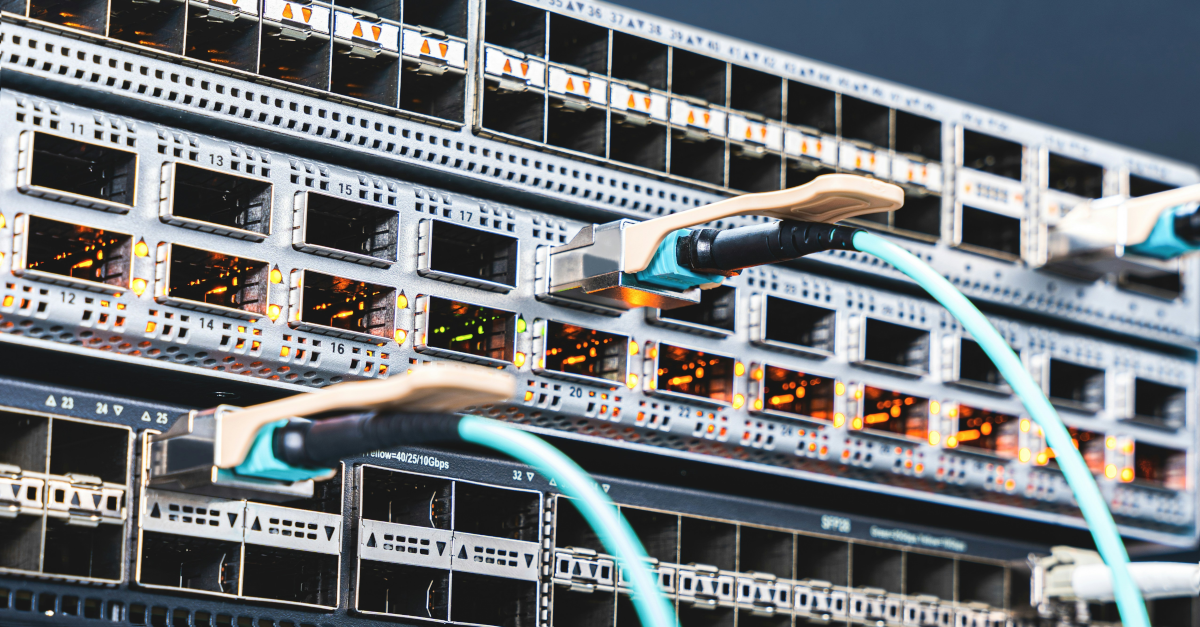
Over the past few years, construction for new data centers has been at an all-time high across the United States. Many of which are happening because of the increasing popularity and usage of generative artificial intelligence (GenAI). But while you’re at home typing your next prompt into a GenAI service like ChatGPT or Gemini, the communities near where the facilities were built are feeling the aftereffects of it.
What data centers are and how they work
Data centers are physical facilities that house and manage an organization’s IT infrastructure, such as servers, storage systems, and networking equipment. Essentially, they are the home of the internet.
For GenAI data centers specifically, they store IT infrastructure that trains, deploys, and delivers GenAI applications. So, whenever someone types and sends a prompt into a GenAI service, it’s processed at the data center then sent back to the recipient within a few seconds. Though sometimes it can have a slight delay depending on the complexity of the request.
Due to the overwhelming demand for GenAI, services can receive upwards of billions of prompts in a single day. ChatGPT, for example, receives over 2.5 billion prompts every day according to IEEE Spectrum. When the severs are being used 24/7 like that, they take a lot of electricity and water to keep up and running.
Electricity makes sense, but water? The explanation is simple. Most data centers use water based cooling systems, like evaporative cooling, to regulate the temperature inside from the constant use. It’s the easiest and most cost effective option.
But, that electricity and water usage is one of the major issues negatively affecting American communities.
Effect on nearby communities
Data centers are water and energy guzzlers.
According to the 2024 United States Data Center Energy Usage Report, data centers used 4.4% of U.S. electricity in 2023 and that number can triple by 2028. Along with that, research done by David Mytton, published in Nature Partner Journals (npj), found that data centers in the U.S. use 163.7 billion gallons of water annually as of 2021. A number that threatens the fresh water supply, since there’s only about 0.5% of Earth’s freshwater available and safe for human consumption.
Considering all that, GenAI data centers alone, use six-times more water and power than traditional data centers do. In Northern Virginia, data centers saw a 63% increase in water usage between 2019 and 2023 and considering the trend, that number has probably grown exponentially in the last two years and will continue to grow if not stopped.
Now, you might be asking, why should we care?
Well, GenAI data centers use so much that it disrupts the supply and demand. By 2028, the average American can expect to pay 19% more for the same amount of electricity they were getting before, according to Integrity Energy. Depending on the area, they could see the same increase in their water bill too.
On top of that, two-thirds of GenAI data centers are built or in development in areas that are already stressed for water according to Bloomberg News. Those areas are at more risk than just an increase in cost though. Americans who live near data centers, especially those who rely on well water, are experiencing decreases in their water pressure and contamination of their supply.
What can be done about it?
There are alternative temperature regulation techniques data centers can use instead of evaporative cooling. IEEE Spectrum notes “air-based and liquid-immersion cooling, using recycled water to cut potable water use, and waste-heat reuse to reduce cooling demand,” is a suitable alternative. Though it’s also important to note that designs that reuse water can increase the demand for electricity by 10%.
Data centers should also be more conscious of the effect they will have on the area when choosing a cooling system. Wetter areas can handle the water intensive cooling systems, while dryer areas can’t. Additionally considering different types of water as a source is an option too.
Penn State’s Institute of Energy and the Environment says that universities and research organizations can play a role in making AI more sustainable. Research and further education of the public can also encourage people to adopt more energy-efficient practices when using and researching AI.
If you hear about a data center coming to your area, you as an individual, have some options as well:
- Talk to your local township, borough, or county representatives and ask them to advocate for changes in the area’s zoning laws.
- Get involved with your community, in-person and on social media, to sign petitions, voice your opinion, and generate discourse.
- Advocate for laws that require sustainable practices to protect your community through grassroots work.
Most importantly, think before you send your next prompt.
Sources
Barnett, J. (17 Dec. 2024). How water reuse can address scarcity. Environmental and Energy Study Institute. https://www.eesi.org/articles/view/how-water-reuse-can-address-scarcity
Barringer, F. (8 Apr. 2025). Thirsty for power and water, AI-crunching data centers sprout across the west. & the West. https://andthewest.stanford.edu/2025/thirsty-for-power-and-water-ai-crunching-data-centers-sprout-across-the-west/
Jonker, A., & Gomstyn, A. (n.d.). What is an AI data center?. IBM. https://www.ibm.com/think/topics/ai-data-center
Smith, M. S. (1 Oct. 2025). What happens when you say “Hello” to ChatGPT?. IEEE Spectrum. https://spectrum.ieee.org/ai-energy-use
Understanding the power consumption of data centers. (n.d.). Socomec Innovative Power Solutions. https://www.socomec.us/en-us/solutions/business/data-centers/understanding-power-consumption-data-centers#:~:text=The%20demand%20from%20data%20centers%20is%20placing,rack%20within%20the%20same%20square%20foot%20footprint.
Yañez-Barnuevo, M. (25 Jun. 2025). Data centers and water consumption. Environmental and Energy Study Institute. https://www.eesi.org/articles/view/data-centers-and-water-consumption
Check out:












Be First to Comment