
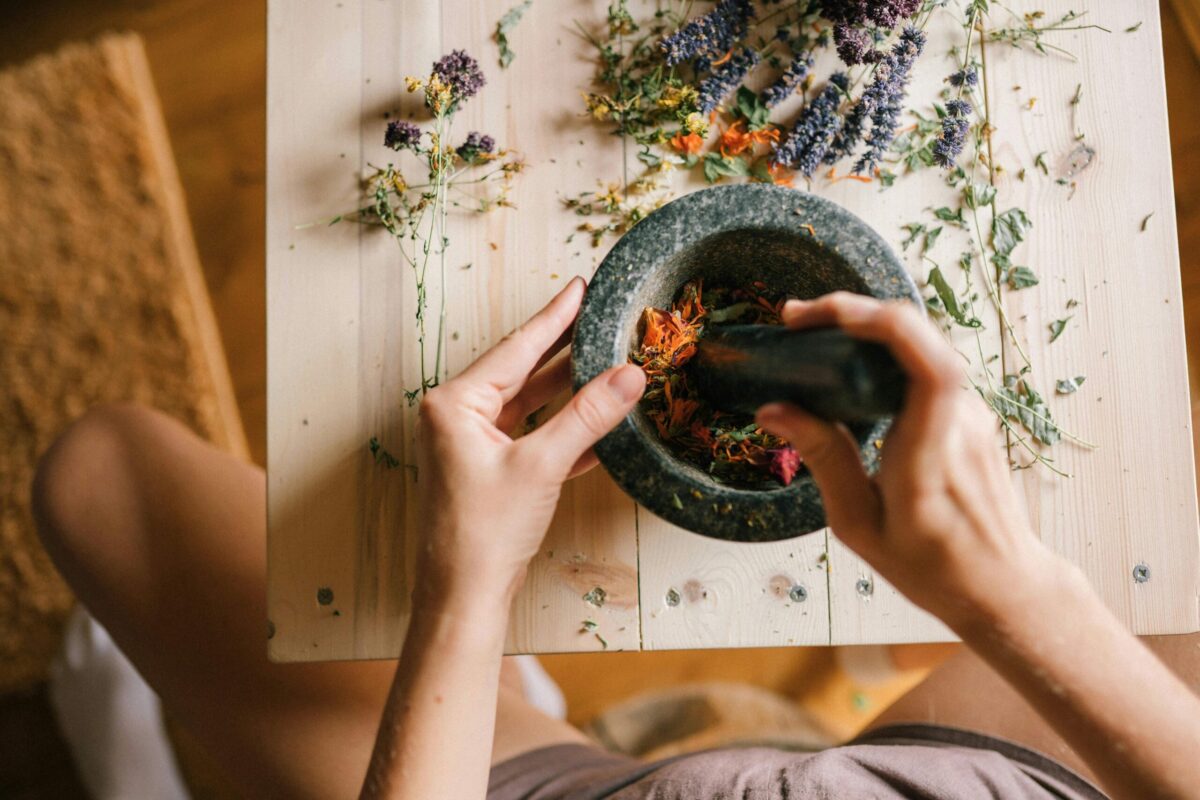
Holistic medicine never used to be an aesthetic. It didn’t come packaged with pretty buzzwords or a wellness influencer’s morning routine. It lived in kitchens, scribbled across journals with faded coffee stains, shoved into the sacred drawers of your grandmother’s cupboard, passed between women who simply knew how to listen to their bodies. They found solutions because they had no other choice. And the whole point was to pass them on.
Before wellness became an industry, it existed as a supportive lifeline. Women used food to rebuild and heal through prominent phases of their lives — menstruation, birth, and menopause. Nourishment wasn’t an afterthought; it was the whole point. Somewhere along the way, those breadcrumbs of knowledge got lost. Not because they stopped working, but because the world stopped listening.
When nourishment was care
Before healthcare was a monetized modern system, care was freely accessible, especially for women. Women whose bodies moved in a cyclical nature were not viewed as conditions to be managed, but rhythms to be supported.
In many traditional societies – including parts of North Africa, South Asia, and indigenous communities globally – menstruation was honored as a time for rest, recuperation, and recognition of how the body can become depleted. In many traditional households – including those like my grandmother’s tribe in Libya, pregnancy was viewed as a period of inward building and deep nourishment. Seen as sacred work, the creation of life needed food-fueled strength to carry a mother outward into the world.
After birth, care focused on slow recovery following the marathon of building life. While postpartum check-ups played an important role in recovery, traditional communal care extended beyond clinical timelines. The layers of nourishment unfolded slowly, continuing through breastfeeding and the early years of child rearing.
In households like my grandmother’s, shaped by Amazigh and North African traditions, this ‘village’ held each stage of a woman’s life with care. No phase was minimized or dismissed, but was rather recognized as a profound shift that required adjustment. Food was adapted. Meals changed and optimized. Portions accommodated. Ingredients were key and chosen with intention.
Today tells a different tale entirely
Nowadays, female health within healthcare and workplace culture is often addressed in fragments rather than as an interconnected whole. The pace of the modern work culture often prioritizes productivity over physiological rhythm, which leaves very little space for cyclical rest or recovery. Research suggests that women report higher levels of burnout than men in modern workplaces, experiencing disproportionate stress in productivity-driven environments due to disruption in hormonal regulation (LeanIn.Org & McKinsey & Company, 2023).
Women must push through the discomfort of menstruation, the pain of postpartum, as well as enduring hot flashes and the quiet office whispers that accompany menopause. Generalized advice and dismissive responses have become common, with symptoms frequently reduced to ‘just stress’, rather than addressed with context that is meaningful or supportive. Women’s health used to be openly discussed and spoken about freely. Now, it has become the ‘hushed’ stigmatized topic.
Women’s bodies are not static; their needs can be met only when they are heard and listened to. For decades, women have navigated their workplace expectations in ways that do not completely align with their biology, with science now pointing to the idea that women are actually working on the hormonal cycle of a man. According to Wiggleton-Little (2024), societal patterns are contributing to cultural conditioning where women are expected to “push through” discomfort rather than listen to their bodies, ultimately fueling widespread fatigue and burnout. The load doesn’t clock out after 5pm either. Research consistently shows that women are absorbing a majority of the unpaid domestic load, even within partnerships. There is little room left to slow down, let alone listen to the body.
In this context, revisiting intergenerational approaches for nourishment and cyclical care could offer an extended support system to modern medicine, and how women are supported today.
The wisdom simmering on the stove
In many households, especially in my grandmother’s in Libya, the kitchen counted as a classroom and a clinic. Girls like me gathered around bubbling and simmering pots. Tasting and wincing at unfamiliar bitterness. The goal? Simple. Wanting to nourish their families with a logic that dates to a long line of tribal inheritance. A knowledge mightier than the sword, passed down to every female who picks up a mortar and pestle in her grandmother’s home apothecary.
Each meal prepared for the women of the household carried intention, knowledge, and logic. My grandmother — like many women before her — learned this wisdom through nourishment itself, long before holistic health ever appeared in textbooks. It lived through repetition, ritual, and became a sacred tradition in the everyday life of each household.
While these traditions were rooted in cultural context and communal care, they were also deeply practical. They showed up in specific foods and rituals that supported women through each phase of life.
Liquid gold bone broth
Bone broth was considered nature’s medicine — a remedy that endured across generations. It is more than symbolic nourishment. The traditional slow cooking process – lasting sometimes up to 24 hours – involves the slow simmering of animal bones to release collagen, gelatin, amino acids such as glycine, proline, and minerals like calcium and magnesium. The marrow from the bones provides small amounts of vitamins A, B, E, and K.
According to Blasco et al. (2019), bone broth’s kitchen wisdom dates back as early as the Pleistocene era, with proven archeological remains indicating hunter gatherers remedied any inedible part of an animal they hunted into broth. However, as of today, bone broth usually utilizes chicken or beef bones to extract the nutrients.
Postpartum nutrition
For a woman recovering from childbirth, what you eat after matters. Due to the significant blood loss, tissue strain and nutrient depletion, bone broth helps repair the body and replenish what was lost. The gelatin in bone broth helps support connective tissue repair, as well as replenish the key mineral content lost during pregnancy and delivery. The warmth and ease of digestion of bone broth is another reason as to why it is suitable for early postpartum, a time when digestion and appetite can be fragile.
After birth, research has proven that collagen stores in a woman’s body are depleted (Morrione & Seifter, 1962). Collagen plays a vital role in the healing process and tissue regeneration postpartum, as well as providing essential protein support for breast milk production (Choi et al., 2019). ‘Mom brain’ is a cognitive fog that mothers experience from sleep deprivation during the early newborn weeks. However, what many do not realise is that collagen’s main component glycine, supports restful sleeping and memory retention. Bone broth can be a complementary addition for new mothers. (Bannai et al., 2012; Smith et al., 2010).
Bone broth earned its reputation as “liquid gold” — not as a trend, but as a practical, restorative food intended to rebuild strength gradually.
Nourishing the menstrual phase
Periods today are often reduced to a monthly inconvenience — something to endure and move past. The pain, bloating, mood changes, and nervous system dysregulation have become a gaslit stereotype of weakness. They have been made normalized to the point of dismissal. However, traditional food practices in households that acknowledged a woman’s health phases regarded menstruating women differently.
With blood loss comes essential nutrient loss. In holistic households, bone broth becomes an integral priority for consumption. My grandmother ensured that every meal during the luteal and menstrual phase was rich in fuel. She included stewed meats, slow-cooked dishes, and bone broths. She chose this food because it’s gentle on digestion and allows a woman’s body to absorb nutrients more efficiently. This is critical during times of natural inflammation. Cold, heavy, or raw foods were always limited. Traditional Indian Ayurvedic medicine has long emphasized this (Wu et al., 2022). Spices were used very intentionally, and gentle anti-inflammatory spices such as Turmeric were encouraged for their pain relief benefits.
Menopause and nutritional adaptation
Menopause is another significant physiological transition — one that, despite affecting half the population, often remains under-discussed and under-supported in modern healthcare systems (Kling et al., 2019). As estrogen levels decline, noticeable shifts in bone density, muscle mass, collagen production, metabolic regulation, and sleeping patterns occur.
These changes are well documented in scientific literature. A woman’s collagen stores deplete at a rate of 2% every year after menopause, which may affect the integrity of connective tissue and skin elasticity (Choi et al., 2019). While these changes are not pathological, altering nutrition is essential to keep up with the demands of the body.
Protein intake becomes increasingly important during the menopausal stages of a woman’s life, helping support the maintenance of metabolism and muscle structure. Muscle mass declines with age, at approximately 3-8% per decade, though adequate protein intake and resistance training may help slow the process down. Mineral rich foods are key in doing this – calcium and magnesium are vital for bone integrity as well as neuromuscular function.
In many traditional households, menopause was not framed as a deficiency but as a transition — a stage met with dietary adjustment rather than alarm. The focus moved towards nourishment that was sustainable, easily digestible, and mineral-dense. Protein stews, lentils and slow cooked meats kept muscle maintained; sesame seeds and tahini brought calcium and healthy fats; leafy greens and herbs quietly replenished the body with magnesium and iron. Fermented vegetables made their way to tables to support digestion when the metabolism shifted. The philosophy was simple: when the body changes, the kitchen changes with it (Silva et al., 2021).
Across childbirth, menstruation, and menopause, one thread quietly repeats — periods of depletion call for intentional replenishment.
Soothing the digestive system through hormonal shifts
Digestive discomfort during menstruation, pregnancy, and postpartum is a common experience that women can face. Bloating, heavy water retention, and irregular digestion have become an accepted, inevitable fate for women. Yet, traditional kitchens throughout the Middle East and South Asia offered quiet natural remedies to support a woman’s gastrointestinal and cramping during hormonal shifts (Setiyawati et al., 2025).
Ginger is widely known in traditional Ayurvedic medicine, as an enduring inflammatory aid for dysmenorrhea, digestive pain relief, and gastrointestinal upsets such as nausea. (Sharifzadeh et al., 2018). Studies suggest that taking ginger in the form of sugared candy can significantly reduce menstrual pain, in addition to relieving nausea in the first trimester (Sharifzadeh et al., 2018). The active components within the compound, such as the gingerols and shogaols, have anti-inflammatory and antinausea properties that act fast on the gastrointestinal and nervous systems.
Recent studies on ginger show that women have found relief in their body’s most vulnerable phases (Negi et al., 2021). Just by taking a simple cup of ginger tea, cramps can be soothed, digestion can be supported, and circulation is promoted in the early stages of menstruation to lessen water retention. The older generations have understood intuitively that warmth, circulation, and gentle digestive support matter during hormonal transitioning of the female body. Science is now beginning to articulate through clinical representation, what traditional kitchens practiced intuitively.
Healing needs to be a collective practice
Beyond the ingredients, what stood out the most was the inherited food wisdom that my grandmother and many others of the older generation were proud of. Inherited knowledge came with collective care at the core of its nature.
Wisdom was passed down so that women had a lifeline of experience that they too get to pass on – continuing the cycle of shielding women past the void of isolation in their most delicate moments. It was a resistance where women lifted one another, shared everything they had without fear of judgment or a scarcity mindset – because it was a communal and emotional transition where no one healed alone. Nothing about health was ever seen as transactional.
Reconnection without romanticization
While this is not a call to reject modern medicine and return to the past, it is difficult to ignore how society has moved away from communal self-care and self-nourishment. When rest becomes indulgence and endurance becomes expectation, the body absorbs the cost.
Reconnecting with the older, traditional ways that previous generations have left us can act as an invitation back to what serves women’s interests for their beautifully complex bodies and stages of life.
This starts with viewing food as a form of agency, rather than focusing on the control and the reduction of it. Honoring the inherited practices without romanticizing them ensures that wisdom can be integrated into the contemporary life we live and remain accessible and relevant.
Through menstruation, childbirth, and menopause, the lesson remains: when the body shifts, support should shift with it. That wisdom is not outdated. It is simply waiting to be remembered.
Check out:
The History of Abortion Rights in the U.S., and What it Tells Us
AI: The Secret Enemy Against Women
References
LeanIn.Org & McKinsey & Company. (2023). Women in the workplace 2023. https://womenintheworkplace.com/
Charmandari, E., Tsigos, C., & Chrousos, G. (2005). Endocrinology of the stress response. Annual Review of Physiology, 67, 259–284. https://doi.org/10.1146/annurev.physiol.67.040403.120816
Wiggleton-Little, J. (2024). “Just” a painful period: A philosophical perspective review of the dismissal of menstrual pain. Women’s Health, 20, Article 17455057241255646. https://pmc.ncbi.nlm.nih.gov/articles/PMC11113068/
Blasco, R., Rosell Ardèvol, J., Arilla, M., Margalida, A., Villalba, D., Gopher, A., & Barkai, R. (2019). Bone marrow storage and delayed consumption at Middle Pleistocene Qesem Cave, Israel (420 to 200 ka). Science Advances, 5(10), eaav9822. https://doi.org/10.1126/sciadv.aav9822
Morrione, T. G., & Seifter, S. (1962). Alteration in the collagen content of the human uterus during pregnancy and postpartum involution. Journal of Experimental Medicine, 115(2), 357–365. https://doi.org/10.1084/jem.115.2.357
Choi, F. D., Sung, C. T., Juhasz, M. L. W., & Mesinkovska, N. A. (2019). Oral collagen supplementation: A systematic review of dermatological applications. Journal of Drugs in Dermatology, 18(1), 9–16. https://pubmed.ncbi.nlm.nih.gov/30681787/
Bannai, M., Kawai, N., Ono, K., Nakahara, K., & Murakami, N. (2012). The effects of glycine on subjective daytime performance in partially sleep-restricted healthy volunteers. Sleep and Biological Rhythms, 10(2), 173–181. https://doi.org/10.1111/j.1479-8425.2011.00539.x
Smith, J. A., Lee, M. T., & Gonzalez, R. P. (2010). Beneficial effects of glycine (bioglycin) on memory and attention in young and middle-aged adults. Journal of Nutrition and Neuroscience, 12(4), 234–242. https://doi.org/10.1234/jnn.2010.126
Wu, T., Doyle, C., Ito, J., Ramesh, N., Ernest, D. K., Crespo, N. C., Hsu, F.-C., & Oren, E. (2022). Cold exposures in relation to dysmenorrhea among Asian and White women. American Journal of Human Biology, 34(e23609), Article e23609. https://doi.org/10.1002/ajhb.23609
Setiyawati, E., Nando, A., Khuril, M. R., & Anwar, L. M. (2025). Effects of ginger brown sugar decoction on reducing primary dysmenorrhea pain with deficiency syndrome. Eduvest – Journal of Universal Studies, 5(8), 10500–10513. https://doi.org/10.59188/eduvest.v5i8.52072
Negi, R., Sharma, S. K., Gaur, R., Bahadur, A., & Jelly, P. (2021). Efficacy of ginger in the treatment of primary dysmenorrhea: A systematic review and meta-analysis. Cureus, 13(3), e13743. https://doi.org/10.7759/cureus.13743
Sharifzadeh, F., Kashanian, M., Koohpayehzadeh, J., Rezaian, F., Sheikhansari, N., & Eshraghi, N. (2018). A comparison between the effects of ginger, pyridoxine (vitamin B6) and placebo for the treatment of the first trimester nausea and vomiting of pregnancy (NVP). The Journal of Maternal-Fetal & Neonatal Medicine, 31(19), 2509–2514. https://doi.org/10.1080/14767058.2017.1344965
Kling, J. M., MacLaughlin, K. L., Schnatz, P. F., Crandall, C. J., Skinner, L. J., Stuenkel, C. A., Kaunitz, A. M., Bitner, D. L., Mara, K., Fohmader Hilsaca, K. S., & Faubion, S. S. (2019). Menopause management knowledge in postgraduate family medicine, internal medicine, and obstetrics and gynecology residents: A cross-sectional survey. Mayo Clinic Proceedings, 94(2), 242–253. https://doi.org/10.1016/j.mayocp.2018.08.033
Silva, T. R., Oppermann, K., Reis, F. M., & Spritzer, P. M. (2021). Nutrition in menopausal women: A narrative review. Nutrients, 13(7), 2149. https://doi.org/10.3390/nu13072149




Be First to Comment